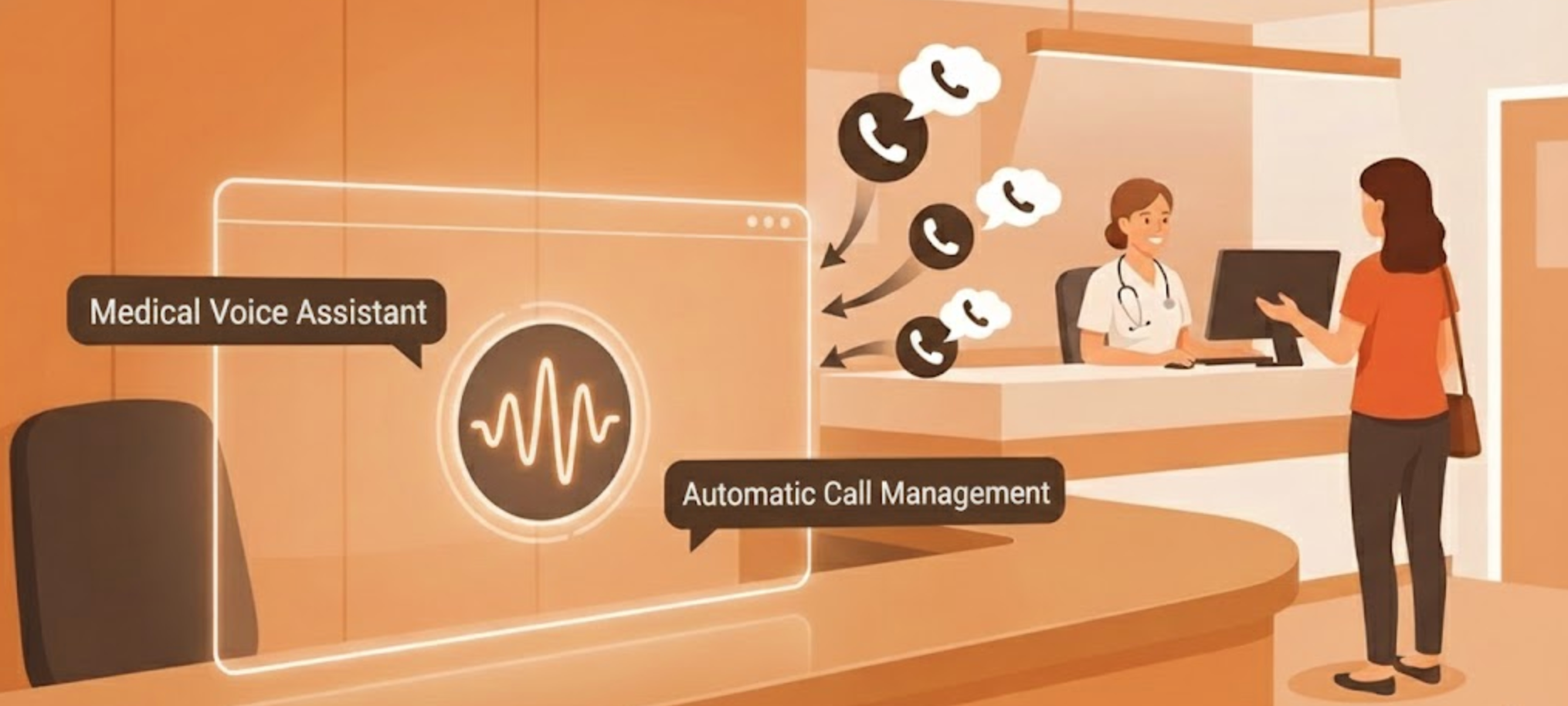

In modern medical practices - radiology, imaging, dental clinics, specialists, paramedical professionals - the telephone has become one of the most critical points in the patient journey.
Receptionists must manage in-person patients, schedules, medical coordination, emergencies, and anxious callers, all while absorbing call volumes that are often impossible to handle.
With the rise of medical voice assistants, the question is no longer “Should we automate?”
The real question is:
“What can AI handle better than humans - and where are humans still irreplaceable?”
Here is what voice agents do better in a medical environment… and where human expertise remains essential.
1. When call volume exceeds human capacity
At peak hours - 8:00 to 10:00, after lunch, late afternoon, or before holidays - a receptionist may receive 40 to 60 calls in 30 minutes.
No human team can absorb that without:
- long waiting times
- unanswered calls
- frustrated patients
- intense stress at the front desk
A medical voice agent answers instantly, with no limit and no saturation.
It stabilizes call flow and prevents patients from entering a cycle of frustration or appointment abandonment.
AI excels in immediate responses and zero overload.
Humans remain essential in emotional or conflict situations.
2. For simple and repetitive requests
In many medical practices, 60 to 80 percent of calls are simple:
“I want to move my appointment.”
“I need to cancel.”
“What are your opening hours?”
“Do you perform this exam?”
“Where is the clinic located?”
These calls consume a huge amount of receptionist time while adding almost no medical value.
A specialized voice agent like Donna handles these perfectly:
- natural language understanding
- direct access to medical schedules (radiology, dental, specialists, etc.)
- immediate execution of actions (cancel, reschedule, confirm)
- automatic SMS notifications
AI excels through speed, consistency, and availability.
Humans remain essential when a “simple question” hides a more complex medical concern.
3. To filter out irrelevant or non-medical calls
Medical centers receive many unnecessary calls:
- commercial calls
- wrong numbers
- irrelevant administrative questions
- patients asking about exams the practice does not perform
A medical voice agent filters these instantly, redirecting or closing the interaction without interrupting the front desk team.
AI excels at strict, continuous filtering.
Humans are essential for ambiguous or nuanced administrative questions.
4. To manage confirmations and appointment reminders
No-shows are rising across all medical fields.
Yet most missed appointments could be prevented with:
- a simple reminder the day before
- an automated confirmation
- a quick rescheduling if necessary
Donna can:
- call patients automatically
- confirm or adjust appointments
- free up cancelled slots
- keep the schedule updated in real time
A human team cannot realistically call 100 to 200 patients per day.
AI excels in repetition, reliability, and precision.
Humans remain essential for urgent clinical priorities.
5. To handle calls outside normal opening hours
Many patient calls happen:
- early in the morning
- after closing time
- during weekends
- on holidays
A human team cannot cover these periods without significant cost.
A voice agent, however, operates 24/7.
This continuous availability improves:
- patient satisfaction
- schedule fluidity
- the practice’s perceived accessibility
AI excels in availability and continuity.
Humans remain essential for urgent medical guidance (Donna can directly transfer these cases).
When humans remain absolutely essential
A voice agent does not replace medical receptionists.
It never will.
Humans remain irreplaceable for:
- anxious or distressed patients
- complex or sensitive clinical situations
- in-person welcome
- empathy, tact, and emotional communication
- nuanced administrative decisions
- questions requiring contextual medical judgment
AI handles what is mechanical.
Humans handle what is sensitive.
The combination is what actually works.
Donna + medical staff: the ideal model
Donna, the voice assistant designed for medical practices, handles up to 80 percent of incoming calls while allowing receptionists to focus on their real jobs: welcoming patients, supporting clinicians, managing urgent cases, and ensuring smooth coordination.
Donna provides:
- instant responses
- fully autonomous appointment scheduling
- integration with Doctolib, Maiia, EasyDoct
- intelligent call filtering
- urgent call identification
- human transfer when needed
- automated reminders and confirmations
Discover Donna: https://callrounded.com/cas-usage/secretariat-medical
Conclusion: let AI handle what it does best so humans can focus on what matters
In a medical practice, every minute counts.
Automating does not remove humanity; it preserves it.
A voice agent handles tasks that are:
- repetitive
- simple
- high volume
- technical
- outside office hours
And humans remain essential for:
- listening
- nuance
- emotion
- real patient relationships
Donna is not a replacement.
She is protection for medical teams - and a guarantee of a consistently excellent patient experience.